
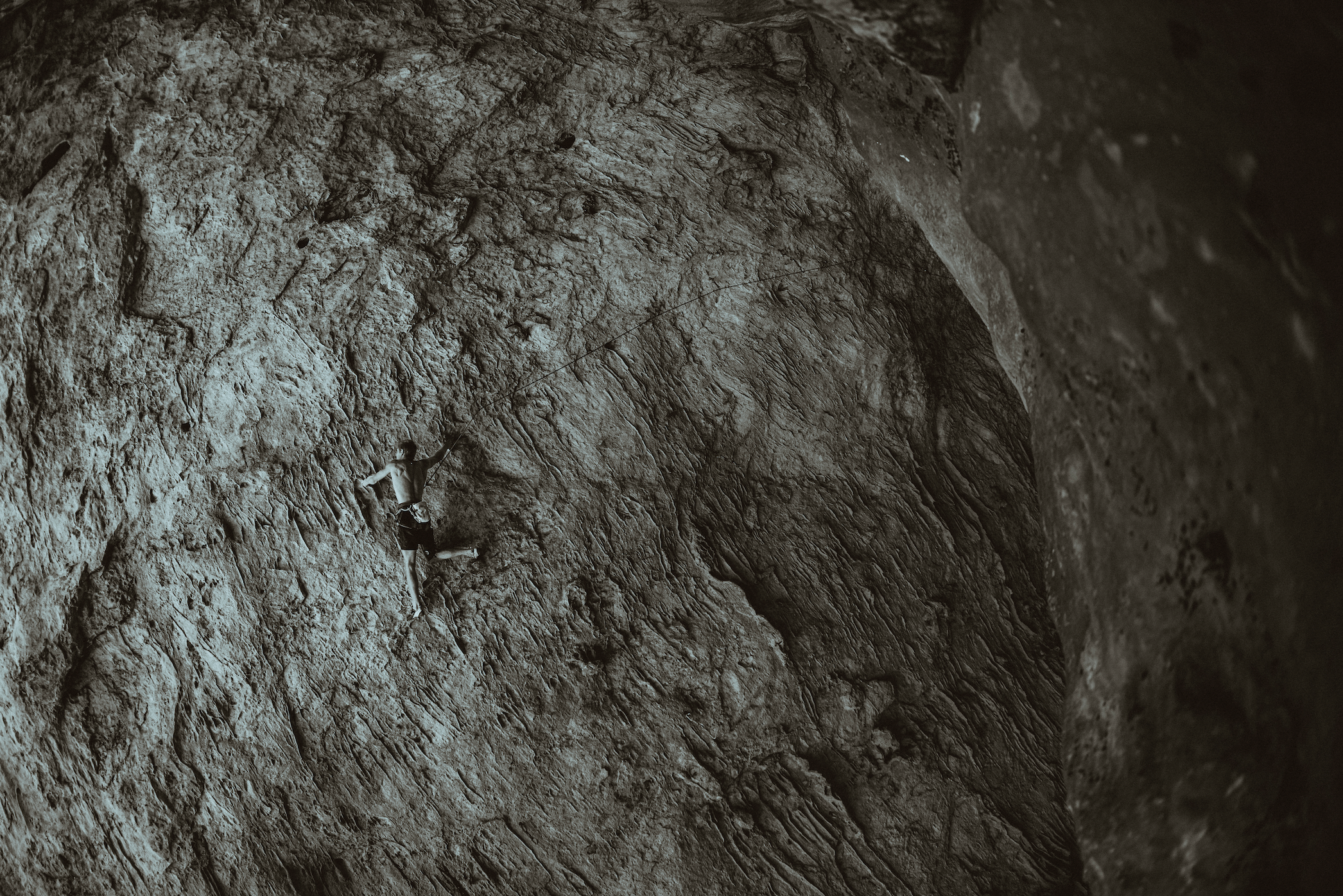
On May 27, 2026, I finished my story on Big Bone. Like any meaningful send, there was the immediate rush of excitement and relief. But more than anything, I felt at peace.
For nearly three years, the route had occupied a significant amount of my attention. It influenced how I trained, how I structured my seasons, and even how I navigate introspective thoughts regarding climbing performance. Sitting on the top of the cave, basking in the sunny breeze, I found myself reflecting less on the send itself, rather mulling on how significant of a developmental process climbing in the Fynn Cave was for me.

Some Backstory on Big Bone
Big Bone climbs through the steepest section of Fynn Cave, following nearly 120 feet of climbing through some of the most impressive limestone I have ever touched. The route begins by climbing the entirety of Bone Tomahawk (9a), established by Joe Kinder in 2016. From there, you arrive at a modest resting position before launching into what is essentially a full-value 8c route through the remainder of the cave.
The route is relentlessly resistant.

How I Approached Preparation
When I first started trying the route, I believed there were two obvious areas of my climbing where I needed to improve.
First, I needed better overall endurance. Second, I needed greater anaerobic capacity (more strength and power) so that every hard move represented a smaller percentage of my maximum effort. My thinking was: if I can arrive at the halfway rest less fatigued, and have a smaller hole to recover from, I will have a chance to fight my way through the second half.
Making those improvements absolutely helped. But as time progressed, I realized that becoming more physically fit was only one piece of a much larger, less obvious, puzzle.
Elite sport climbing often appears to be a display of extraordinary physical ability. We watch videos of the pros float through seemingly impossible sequences and naturally assume that years of intense training are what separate them from everyone else. In part, that's true. However, what seems to get overlooked once someone possesses superhuman physical prowess, is their ability to get their mind in a place that elicits peak performance. A tall task, and super subjective to the individual.
Becoming a Better Projector
As I realized my physical fitness was less of a limiting factor, I became increasingly interested in another question: What emotional state allowed me to best express the fitness I had spent years developing?
Early in the project, my answer was intensity.
I would intentionally put myself in an emotional state of aggression. I'd listen to heavy music, think about things that made me angry, and convince myself I needed to attack the route. At the time, it made perfect sense. Big Bone was a fight, and I wanted to show up ready.
Over time, I realized that was the wrong paradigm to operate in.
The stronger I became, the less I needed to manufacture intensity. Once I realized that my body was already capable of climbing the route, the challenge was no longer creating more effort. Rather, creating the emotional conditions that allowed my body to express the work it had already done.
Instead, I began trying to cultivate peace.
I became intentional about the thoughts I entertained before leaving the ground. Rather than dwelling on frustration, pressure, or wanting to prove something, I tried to fill my mind with things that come from a place of love and gratitude. Whether you describe that as operating from a higher vibration or simply from a healthier emotional state, I found that those thoughts consistently produced my best climbing.
That subtle tweak of mental disposition was game changing for me. Now, I can take this season of learning and apply it to the next, bigger, project. Whoop!

